显示标签为“Lhasa Tibet”的博文。显示所有博文

2016年6月26日星期日

How to Plan a Mount Everest Tour

How to Plan a Mount Everest Tibet Tour is a dream to many travelers, and to see Mount Everest is a much-looked-forward-to experience. Mount Everest is, the world's highest mountain, is really the top of the world. And the best place for non-mountaineers to see the summit is from China's Mt. Everest Base Camp (EBC).

When to Go
Though you can travel to many places regardless of the season and weather, you should definitely pay attention to when is the best time to see Mount Everest. Avoid rainy weather, as for any remote mountainous location, especially if you want to camp. For Mount Everest, also consider ice, wind and snow.

starred skyView of starred sky of Everest at Everest Base Camp in clear days
The best time to go is from late April to early June, and late September to early November, as there is little rain and snow, and daytime temperatures are above freezing.

Avoid winter time from November to April due to harsh weather conditions. Also Tibet is usually closed in February and March.

We don't recommend you to go in summer, because summer is the rainy season in Tibet, especially July and August. The summit is usually covered by mist/cloud and you have less chance of seeing the peak.

Permits Required
To enter Tibet you need a Tibet Entry Permit, and to visit Mount Everest you need an Aliens' Travel Permit.

You are not allowed to apply for the tibet permit by yourself and you can't travel Tibet without atibet tour guide. You need to find a travel agency to help you arrange it. China Highlights offerstibet Permit + private guide service, and all our Tibet tours include our assistance in getting the required permissions.

Getting There and Returning
Fly to Tibet and Leave by Train

tibet trainScenery along the railway
Many travelers want to experience the Tibet Railway. But it's far easier to get flight tickets to Tibet, and train tickets out of Lhasa. You can take time to adjust to the high altitude in Lhasa, rather than in the confines of a train, before beginning your journey in Tibet.

After enjoying Tibet, you can take time to enjoy the natural beauty from a train on the way out. You won't miss anything of the Tibet experience by travelling this way, and your plans are far less likely to be curtailed due to lack of train tickets.

To Mount Everest by Road

Mt. Everest Base Camp is far from Lhasa, and only a good transport solution will allow you to enjoy a smooth trip. We don't recommend buses.

road from shigatse to ebcFrom Shigatse to Everest Base Camp
The most popular and comfortable way to go by road is to hire a van and a driver.

With China Highlights, after your trip in Lhasa for the Potala Palace, Jokhang Temple, etc, your driver and tour guide will pick you up at your hotel. It will take about 2 days from Lhasa to Rongbuk Monastery, about 3.6 km (2.2 mi) north of EBC. Then you need to out and take the shuttle bus or walk to EBC.

To Mount Everest by Rail and Road

You can take a train to Shigaste now the Lhasa–Shigatse Railway is open. The journey between Lhasa and Shigatse is about 3 hours. There is only one train between Lhasa and Shigatse per day.

Train Departure Arrival Ticket Price
K9821 Lhasa—Shigatse 9:00 11:59 Hard seat 41   $7
Hard berth 209  $35
Soft berth 319  $52
K9822 Shigatse—Lhasa 17:30 20:27 Hard seat 41   $7
Hard berth 209  $35
Soft berth 319  $52
8 Days Needed
the Potala PalaceSpend couple of days in Lhasa to discover Tibet culture.
You should not go to EBC on the same day you arrive in Tibet due to the high risk of acute altitude sickness. It is recommended to spend three days in Lhasa and Shigatse to acclimate and discover Tibetan culture, and arrange your Aliens' Travel Permit, before going above 4,000 meters.

The typical 8-day Everest itinerary is made up of: three days basic acclimatization, a night for further acclimatization in Dingri, two days for the EBC visit and return to Lhasa, and Lhasa arrival/departure days. See our Mount Everest tour.

Packing List
creamBring lip balm and moisturizer.
Sun cream: Bring strong SPF sun cream to protect your skin from the strong sunlight.

Sun glasses/snow glasses: The ultraviolet light is very strong when up in the mountains. So bring sun glasses to protect your eyes and bring snow glasses to prevent snow blindness if you go to see Mount Everest in the snowy season.

Lip balm and moisturizer: Tibet has a dry and cold climate, so take measures to avoid chapped lips and dehydrated skin.

Down jacket (and warm sleeping bag if camping): It's very cold at night at EBC, even in summer. The quilts in EBC tent hostels may not be enough to protect you from the cold.

Good/spare batteries: There is not much electricity at EBC, so you need to charge your phone or camera and batteries before the final leg of your journey. The cold will sap battery life, so keep devices/batteries insulated.

Food: Bring enough food with you for the long journey if you can't get used to the local food. There is little choice for food at EBC tent hostels.

Medicine to reduce altitude sickness

FAQs
1. Do I have to camp in EBC? I don't like sleeping in tent.

You don't have to sleep in tent. You can stay in Rongbuk Monastery Hotel, about 7 km (4 mi) north of Mount Everest, or a Dingri hotel. They offer basic facilities: a bed and quilts like tent hostels, but they will be a bit warmer, and you can have your own bathroom, bedroom, and more space. Western food is not available. See our Mount Everest page for more on EBC facilities.

2. If I fly to Tibet, can I see Mount Everest on the plane?

If you fly to Lhasa from Kathmandu, Nepal, you may see Mount Everest on the left on a clear day.

3. I heard that it's very easy to get altitude sickness at EBC. What should I do to avoid it besides medicine?

You should take about three days to get used to the high altitude in Lhasa, Shigatse, and Dingri on the way. Avoid strenuous actions, quick movements, and jumping. If you get headaches and dizziness taking bottled oxygen or moving to a lower altitude for further acclimatization can help.

4. Can I use my phone at EBC?

Yes. The telephone signal covers EBC, but can be unstable. But do make sure that you have charged your phone and back-up batteries in your hotel before your departure, because there is little electricity at EBC.

5. What else can I experience besides viewing Mount Everest at EBC?

You can appreciate the sunrise/sunset at EBC in clear days. The starry sky at night is also very spectacular. And there is a China Post Office at EBC where you can buy and send your family postcards from Mount Everest.

Overland to Tibet - Tibet Road Map and Guide

If you want to have a road trip in lhasa tibet, the first thing you should do is to know the road map in tibet.
Currently, there are five highways to Tibet, namely the Sichuan Tibet Highway, Xinjiang Tibet Highway, Qinghai Tibet Highway, Nepal Tibet Friendship Highway and Yunnan Tibet Highway, as show on the Tibet Road Map below.
Due to the poor and rough road conditions, driving to Tibet used to be extremely difficult. However, in recent years, with the improvement of the living standard and transport services on the plateau, self-drive tours to Tibet have been becoming increasingly popular. Now, vehicles from different parts of China can be seen along the Qinghai-Tibet highway and Sichuan-Tibet Highway.
Among the five highways, only Qinghai-Tibet Highway and Sino-Nepal Friendship Highway are open to foreigners at present.
The Qinghai-Tibet Highway starts from Xining, running through the mountains of Kunlun and Tanggula, via Golmud, and reaches Lhasa, with a total length of 1,214 kilometers long and an average elevation of above 4,000 meters. It takes visitors the shortest time to Tibet with the best and safest road comparing to other highways. As the terrain is desolate, it’s not recommended and you may have a better time on the train to Lhasa, Tibet.
Many travelers book overland Tibet tours via the Sinao-Nepal Friendship Highway that runs from Kathmandu (capital of Nepal), through Zhamud Friendship Bridge and reaches Lhasa, with a total length of 920 kilometers. It takes three to five days with stops at sights along the way.
Roads in Tibet
A transport network centered around Lhasa has taken shape in Tibet, covering various parts of Tibet and provided outlets to China’s hinterland and countries in Central and South Asia. Click to check out the road conditions in Tibet for your trip.

2016年6月15日星期三

Avoid Altitude Sickness


What is Altitude Sickness?

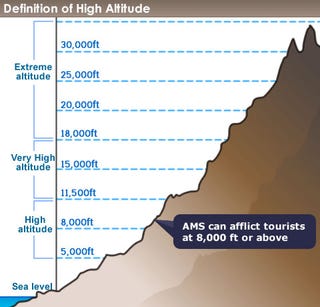
At over 3,000 meters (10,000 feet) 75% of people will have mild symptoms. The occurrence of AMS (Acute Mountain Sickness) is dependent upon the elevation, the rate of ascent, and
individual susceptibility. Many people will experience mild AMS during the acclimatization process. The symptoms usually start 12 to 24 hours after arrival at altitude and begin to decrease in severity around the third day.
The symptoms of Mild AMS include:
  1. Ÿ Breathlessness & Headache
  2. Ÿ Nausea & Dizziness
  3. Ÿ Loss of appetite
  4. Ÿ Fatigue
  5. Ÿ Shortness of breath
  6. Ÿ Disturbed sleep
  7. Ÿ General feeling of malaise
Almost every visitor is affected by the high altitude in Tibet. The reaction may vary from person to person. This has nothing to do with age or sex, but it does have to do with physical fitness. Most of the visitors get acclimatized to the high altitude by taking it easy for one or two days. All these symptoms can be potentially life-threatening conditions that may only be relieved by moving to a lower altitude; travelers should inform themselves about the symptoms so that they can recognize them. The high altitude and people’s reaction to it is one of the difficulties to travel to Tibet. But it is not as serious as you imagined if you know it and get prepared for it.

Prevention of Altitude Sickness

The major cause of altitude illnesses is going too high too fast. Given time, your body can adapt to the decrease in oxygen molecules at a specific altitude. This process is known as acclimatization and generally takes 1-3 days at that altitude. For example, if you hike to Yampachen at 4,300 meters, and spend several days at that altitude, your body acclimatizes to 4,300 meters. If you hike to EBC at 5,200 meters, your body has to acclimatize once again. A number of changes take place in the body to allow it to operate with decreased oxygen.
  1. Ÿ The depth of respiration increases.
  2. Ÿ Pressure in pulmonary arteries is increased, “forcing” blood into portions of the lung which are normally not used during sea level breathing.
  3. Ÿ The body produces more red blood cells to carry oxygen.
  4. Ÿ The body produces more of a particular enzyme that facilitates.
  5. Ÿ The release of oxygen from hemoglobin to the body tissues.
Acclimatization
  1. Ÿ Do not over-exert yourself or move higher for the first 24 hours.
  2. Ÿ If you go above 10,000 feet (3,048 meters), only increase your altitude by 1,000 feet (305 meters) per day and for every 3,000 feet (915 meters) of elevation gained, take a rest day.
  3. Ÿ “Climb high and sleep low.” This is the maxim used by climbers. You can climb more than 1,000 feet (305 meters) in a day as long as you come back down and sleep at a lower altitude.
  4. Ÿ If you begin to show symptoms of moderate altitude illness, don’t go higher until symptoms decrease (Don’t go up until symptoms go down).
  5. Ÿ If symptoms increase, go down, down, down!
  6. Ÿ Keep in mind that different people will acclimatize at different rates. Make sure all of your party is properly acclimatized before going higher.
  7. Ÿ Stay properly hydrated. Acclimatization is often accompanied by fluid loss, so you need to drink lots of fluids to remain properly hydrated (at least 3-4 quarts per day). Urine output should be copious and clear.
  8. ŸTake it easy; don’t over-exert yourself when you first get up to altitude. Light activity during the day is better than sleeping because respiration decreases during sleep, exacerbating the symptoms.
  9. Ÿ Avoid tobacco and alcohol and other depressant drugs including, barbiturates, tranquilizers, and sleeping pills. These depressants further decrease the respiratory drive during sleep resulting in a worsening of the symptoms.
  10. ŸEat a high carbohydrate diet (more than 70% of your calories from carbohydrates) while at altitude.
  11. Ÿ The acclimatization process is inhibited by dehydration, over-exertion, and alcohol and other depressant drugs.
Preventive MedicationsDiamox (Acetazolamide) allows you to breathe faster so that you metabolize more oxygen, thereby minimizing the symptoms caused by poor oxygenation. This is especially helpful at night when respiratory drive is decreased. Since it takes a while for Diamox to have an effect, it is advisable to start taking it 24 hours before you go to altitude and continue for at least five days at higher altitude. The recommendation of the Himalayan Rescue Association Medical Clinic is 125 mg. twice a day (morning and night). (The standard dose was 250 mg., but their research showed no difference for most people with the lower dose, although some individuals may need 250 mg.) Possible side effects include tingling of the lips and finger tips, blurring of vision, and alteration of taste. These side effects may be reduced with the 125 mg. dose. Side effects subside when the drug is stopped. Contact your physician for a prescription. Since Diamox is a sulfonamide drug, people who are allergic to sulfa drugs should not take Diamox. Diamox has also been known to cause severe allergic reactions to people with no previous history of Diamox or sulfa allergies.
Dexamethasone (a steroid) is a prescription drug that decreases brain and other swelling reversing the effects of AMS. Dosage is typically 4 mg twice a day for a few days starting with the ascent. This prevents most symptoms of altitude illness. It should be used with caution and only on the advice of a physician because of possible serious side effects. It may be combined with Diamox. No other medications have been proven valuable for preventing AMS.
Both Diamox and Dexamethasone are Western Medicine. You are recommended to consult your doctor for the prescription as they can have some serious side effects.
Tibetan Herbal Medicine-Hongjingtian and Gaoyuan’an are very good preventive and treatment effects for Altitude Sickness and AMS (Acute Mountain Sickness). Honjingtian and Gaoyuan’an (Rhodiola Eoccinea and Hippophae) may help sleep at high altitude and thus increase oxygenation at night. The two Tibetan Medicines can be quite effective in treating altitude sickness. But it also has one side effect: if you take the medicine, your alcohol resistance will be higher, i.e. you can drink more before you get drunk. In accordance with theories of modern medicine,” oxygen deficit is the mother of all sickness”. Highland Hongjingtian can better regulate oxygen deficit in the local parts of the internal organs of human beings, can increase the degree of blood oxygen saturation, generating self-cure immunity, and thereby enhance life vitality. In addition, Hongjingtian has also function of relieving alcoholism (more alcohol can be consumed when in taking this kind of beverage before or after).
The altitudes of different places in Tibet
PlaceAltitudePlaceAltitude
Lhasa3658 mNyingchi3000 m
12001 ft9843 ft
Nagqu4507 mTsedang3500 m
14787 ft11483 ft
Qamdo3205 mShigatse3836 m
10515 ft12585 ft
Damshung4200 mGyantse4040 m
13780 ft13255 ft
Pome2750 mTingri4300 m
9022 ft14108 ft
Amdo4800 mZayui2325 m
15748 ft7628 ft

Who’d better not come?

  1. Everyone should have more or less altitude symptoms. However, those who have the following symptoms may not come to Tibet
  2. Someone relating to tuberculosis, pneumonia, serious tracheitis, bronchitis
  3. People who suffer from high blood pressure and severe heart disease should seek medical advice before going to Tibet.
  4. Have already got a serious cold.

Health Considerations

Because of its high altitude, largely remote destinations, and semi-arid weather Tibet comprises a unique set of health concerns. You don’t need to worry about Malaria or odd strains of para-typhoid here, but you should certainly consider the sun and altitude.
We do not want to supplant advice from professionals and more complete suggestions available in guidebooks, so we suggest you consult appropriate sources before coming. Our trips our designed so you do not over-exert yourself in the first few days, and our guides are experienced and aware of the dangers of altitude sickness. There is preventative and symptomatic medication to help with the minor symptoms of altitude sickness (headaches, nausea) and we recommend that you bring some.
We also strongly suggest that you bring sunglasses, hat and sunscreen — Tibet is not the place to work on your tan. Further clothing and equipment depends on the type of trip you are doing here. We are happy to make suggestions or recommend published sources for more information on appropriate supplies.
If you want to know more,please click me.
GreatTibetTour.com is an online travel agency and group tibet travel operator, offering affordable Tibet tour,lhasa tibet,walking holidays, Trekking Tour,road trips,the largest low cost tour operator in Tibet and to make the dream of traveling to Tibet possible for everyone.We can also help you to get the tibet permit and provide many travel tips.

2016年5月23日星期一

10 Dos and Don’ts for a First Visit to Lhasa Tibet


If you want to have a walking holidays in Lhasa Tibet, and support the local Tibetan economy, check out this list of Lhasa dos and don’ts. This is not so much a list of the top sites of Lhasa as much as it is our suggestions on how you can have a more meaningful experience.
Here is some travel tips for you.
1. Do choose a great, Tibetan-owned travel agency
This first decision of your trip is the most critical one. Since no independent travel is allowed to Tibet and you must work with a travel agency, you want to be sure to choose a Tibetan-owned agency, which hires Tibetan guides only.
2. Don’t miss walking the koras
Lhasa Tibet is chock full of kora – walking paths around sacred sites that one circumambulates, usually while praying, meditating or prostrating. Pretty much every temple and monastery will have a kora, and these are great places to mingle with Tibetans from all walks of life. Notice that Tibetan Buddhists walk in a clockwise direction when circumambulating.
The Potang Shakor:
Walking the koras can seriously change your experience of the common “tourist” sites. Take the famous Potala Palace as an example. Almost every visitor to Lhasa Tibet wants to see the inside of the Potala at least once, even though it’s pretty depressing. So sure, go ahead and stagger, oxygen-deprived, to the top floors of the Potala’s lifeless halls to see the rooms in which His Holiness used to live. But then when the tour buses zoom off to another “Tibetan experience,” take some time and walk around the Potang Shakor, the prayer path around the bottom of the Potala. And there you will find Tibetans from all walks of life, Lhasa folk and pilgrims, doing what many of them do every day or as often as they can, circling the Potala, praying for the long life and good health and return of His Holiness the Dalai Lama, and for all sentient beings.
The Drepung and Sera Koras:
If you are able, you’ll want to walk – or, honestly, hike – the koras around two of Lhasa’s great monasteries: Drepung and Sera. You get a different perspective on the monasteries from the hills behind or around them. You can see more clearly, for example, the ruins of the buildings damaged the Cultural Revolution (as in the photo below). The views alone are worth it, but you’ll also have the company of common Tibetans, and it can be a very peaceful and lovely experience, especially if you have any Buddhist tendencies yourself.
The Jokhang Koras: 
There are two great kora around the Jokhang Temple. One is inside the Jokhang enclosure, going around the edge of the temple. The other is the Barkhor, the circular path that circles the Jokhang. The Barkhor supports a lively outdoor market, but at its heart, it is a prayer path around the most sacred temple in Tibet, the Jokhang.
The Lingkhor:
The lingkhor is the big daddy of circumambulations, a 5-mile (8 kilometers) kora that encompasses the whole heart of Lhasa Tibet. The path is not at all easy to find or navigate on your own, without a local, so you’ll need to ask your guide. There are no signs and no special starting point. You just join the path from wherever you are (a nice metaphor for the Buddhist path). Because a good deal of today’s lingkhor passes through the city streets of Lhasa, a lot of it is not beautiful or ancient. There is some of that, like the striking red painted walls of the bottom of the Chokpori and the Medicine Buddha area. But it’s just awesome to walk this path early in the morning (we started around 6 A.M.) with a bunch of Tibetans. When you’re done or close to done, you can drop off at a local tea shop along the way for some sweet tea or butter tea with the local mola’s and pola’s (grandmas and grandpas).
.
3. Do check out the Tromsikhang
The Tromsikhang is a free-wheeling outdoor market off the north side of the Barkhor, with a bunch of closely packed food vendors and some narrow side streets lined with stalls full of truly miscellaneous objects: scissors, clothes, and plastic cups, for example. In the food section, note that the stands with big wedges of what looks like cheese is actually usually butter from the female of the yak species, the dri.
Emma from England, on her trip using a referral from YoWangdu Tibetan Culture:
The sights and sounds of Tibet will remain with me for the rest of my life…The trip was over too quickly but it has become number 1 of the more than 120 countries and islands I have visited in my life…
If you are planning a trip to Tibet, we can put you in touch with a reliable Tibetan-owned agent who will plan a non-touristy trip that gives you a real feel for Tibet.
4. Do request Tibetan hotels and restaurants
Once you have chosen your Tibetan agency, and have your Tibetan guide, you should request that the agency book you exclusively into Tibetan-owned hotels, and bring you to Tibetan-owned restaurants and shops. (Of course ask for clean and good restaurants!) By these simple actions alone, you will avoid a wide range of fake “Tibetan” experiences, will have a much more authentic experience, and will further support the local economy. Note that you can get Western-style food at some Tibetan-owned places, if that’s what you want sometimes. We don’t have a list (yet) of great Tibetan-owned hotels and restaurants in Lhasa, but your guide can help you with this.
5. Do visit the Ramoche Temple and the Tsepak Lhakhang (Long-Life Shrine)
The Ramoche Temple, about a kilometer north of the Jokhang, is historically significant, built as a companion to the Jokhang. The Ramoche’s main image represents the Buddha Shakyamuni at eight years old, and interestingly, may have come from the Jokhang temple, as a replacement for the preciousJowo Rinpoche statue, also of Shakyamuni as a child – which is the soul of the Jokhang now – but which originally sat in the Ramoche. We should say that the Ramoche may seem a poor, drab cousin of the Jokhang and definitely lacks its splendor. The Lonely Planet travel books note that some people may think the 20 yuan entry fee is not worth it, and that may be true. Still, we recommend that you check it out, as a spot that tons of local Lhasa folk visit on a daily basis. Walk the kora, and then when you leave, check out the lively nearby Tsepak Lhakhang (Long-Life Shrine), with long-life prayers filling the air.
6. Don’t eat at the monastery cafeterias
We have found the food at the monasteries to be pretty gnarly and got sick after some momos from Drepung. Check it out yourself if you are interested but we would suggest you bring your own day snacks if you think you’re going to be at Drepung or Sera at meal time.
7. Don’t buy fake “Tibetan” medicine or fake “Tibetan” anything if you can help it
There’s a lot of fake “Tibetan” stuff floating around Lhasa, and one of these is fake Tibetan medicine that supposedly comes from the Mentsikhang, the Tibetan Medicine Institute, but is actually produced by Chinese vendors. If you are interested in Tibetan medicine, go the Mentsikhang itself, just off the Barkhor Square. You’ll find also a bunch of fake Tibetan antiques for sale in Lhasa. Unless you yourself are an expert, we suggest you don’t buy any antiques, especially since even if something is by chance real, it could very well be stolen from the original source. We will look into trying to find reputable vendors for carpets and art in Lhasa, but at the moment, we don’t know of any way to be sure you’re getting the real thing.
8. Do visit the Ani Tsamkhung (Nunnery)
This calm little oasis near the Barkhor is one of the main nunneries in Lhasa. It’s nice just be in the flower-filled courtyard, and you can visit King Songtsen Gampo’s meditation place.
9. Don’t visit the Tibet Museum
The main purpose of the museum appears simply to be espousing a one-sided view of Tibetan history. It’s described by some TripAdvisor reviews as “boring,” “pedestrian,” and “pure propoganda.”
10. Do visit the Nyetang Lhachemo and the Nyetang Dolma Lhakhang
You can visit both of these on the way to or from the airport if you fly. The Dolma Lhakhang is significant partly because it is one of the very few temples to survive the Cultural Revolution. So the temple is the real deal.
The Dolma Lhakhang is famous for the “Talking Dolma” statue (Dolma Sungjun), now lost, which was a bronze statue of Green Tara which is said to have spoken prophecies to certain people. The temple is also known for its relation to Atisha, the renowned Indian Buddhist master. The name Nyetang signifies Atisha’s joy among the Tibetans in that place. The lhakhang is not spectacular to look at, but it is a truly special place all the same.
About 5 kilometers away, just off the road, is a large (two or three stories tall) painted rock carving of the Buddha Shakyamuni, with a bunch of khata, blessing scarves, thrown up onto the rocks.
*There are definitely things you will want to see that are not listed here, like the murals at the Norbulingkha’s Kelsang Potrang, His Holiness the 14th Dalai Lama’s former summer palace.)